I’ve been thinking a lot about writing recently. Prompted by many things: it’s undergraduate dissertation time—I’ve been reading student essays for my external examiner role and internal moderation at work; having discussions with colleagues about revalidating degree courses; pondering what I’m going to write about here next. But also, because I’ve been toying with the idea of blogging on Substack.
I moved away from general blogging in 2016 to concentrate on my writing about graphic design and visual culture, and in doing so I retired my long-running Dubdog Wordpress site. A few months ago though, I stumbled across Substack after several writers I admire moved over to the platform, and I’ve enjoyed the freedom it seems to have given their voices. Some seem to use it in a disciplined way, much like I try to do with my design writing here. Others write about whatever they feel like with no singular focus, and from what I’m reading from this group, it feels very much like blogging in 2006 all over again.
I often find myself questioning what sort of writer I am and why I do it. In Ian Lynam’s book War With Myself: Essays on design, culture & violence, he asks the same of himself and comes to the conclusion that: “I think a big part of it is the ordering of things. The inside of my head is a constant battlefield of epic proportions, and I need time to sit and figure out how every single moment comes together.” (2024, p4.) I feel similarly—for me, writing is thinking: it helps me work things out, making meaning of my thoughts through the consideration of the words I choose to express them.
I’m not a natural writer. At school I failed my O’ Level English language twice before scraping a D grade on my third attempt. Some of this comes from a poor primary school education where my parents had to intervene because they were worried that my reading wasn’t advancing as it should, so I didn’t have a good start. That, and I suspect, undiagnosed dyslexia, which was not considered a thing in the 1970s English school education system.
The fact that I wasn’t interested in anything I was asked to write about also played a large part in my (lack of) writing development. It wasn’t until I did my undergraduate degree as a mature student and I could choose what to write about that I started to enjoy expressing my thoughts through writing. I was so immersed in the topic of my dissertation that I promptly overwrote it by several thousand words, bringing my grade down as a result. I didn’t care though.
Despite this, I still found the process a chore. When I did my PGCE teacher training course, which consisted mostly of writing countless essays, my wife would proofread what I wrote and alert me to how much waffle there was, and the needless repetition. As a result I discovered the art of iteration—writing and editing, writing and editing, writing and editing. It appealed to my pedantic side trying to bring the word count down and I started to see the process as a craft. I learned to hone what I wanted to say, and this suddenly felt a lot like the (my) design process.
The point I realised that I could be a writer though, and that my critical analysis was heightened through writing, was when I wrote an essay to accompany my first self-published photobook, McJunk, (2011). It was a personal photographic project that up until that point had no rationale, it was merely a visual documentation of my observations. But the photobook needed an introduction, and writing one forced me to make sense of what I was doing. It turned McJunk from a vanity project into a critique.

My writing has developed alongside my career as a graphic design educator since that point, and the rudimentary blog posts I posted back in the mid-2000s seem far removed from how I write now. However, I don’t identify as an academic writer, and I prefer to call myself an academic who writes. The difference may seem semantic, but the reality is that I write for audiences beyond academia: students, design practitioners, those with a general interest in visual culture, the public at large, rather than just writing to a narrow academic audience. Rick Poyner says: “If critical graphic design is more than an aloof intellectual pose, it should spend less time hanging out with artists, turn its intelligence outward and communicate with the public about issues and ideas that matter now.” (2023, p276). I completely agree, although in my case I’d swap the word artists for academics.
Being an academic means needing to write though, and often ‘academic writing’ is far down the list of what a lecturer’s output looks like. As Ian Lynam states: “…teachers are never going to become ‘great’ writers…because we are too busy writing,” (2024, p14).
“A giant part of teaching involves different aspects of writing—the syllabi, the grading/copy-editing/grammatical suggestions, the bios drafted, the lectures written, the evaluations, the thesis edits, the faculty video scripts, the program blog posts, the program Tweets, the Instagram captions, the student work PDFs commented, the school blog interviews, the occasions where I’m interviewed, the letters of recommendation, the student researcher applications, the incessant committee emails, the incessant faculty advising emails, the incessant administrative emails, the incessant ad nauseam, the incessant ad infinitum—to be a teacher of worth and of longevity, you must love to write.” (Lynam. 2024, p13.)
He’s right. As well as Lynam’s well composed list, this academic year I’ve also had to write proposals, examiner reports, job descriptions, interview questions, interview tasks, committee terms of reference, action plans, introductory emails, marketing copy, project briefs, agendas, student activities, responses to questionnaires, internal moderation notes, student feedback, interviewee feedback, and much more besides. To be an academic is to write, whether you are writing academically or not.
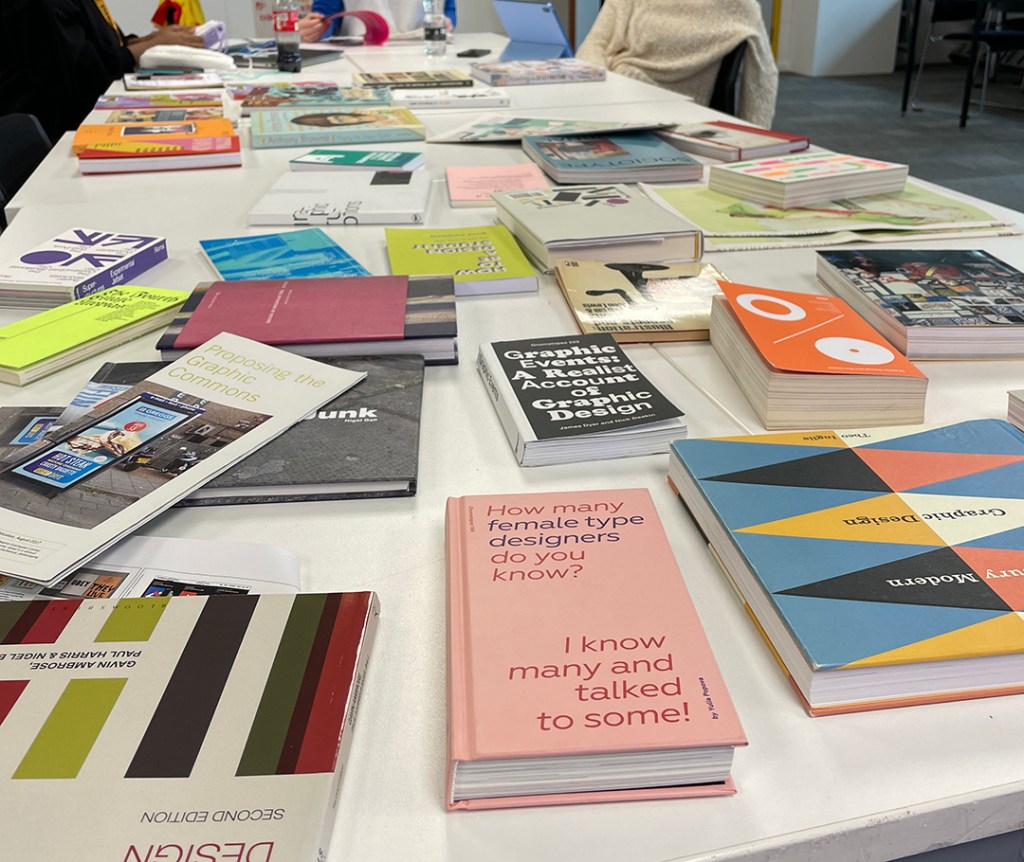
Five years ago, when we were revalidating our undergraduate graphic design course, I wrote a new module called Applying Critical Perspectives for second year students. Part of this programme was simply updating our previous Level 5 introduction to the Level 6 dissertation—teaching students the skills they need to succeed at the next level and giving them a trial run to test out those skills. Part of the reason why I wanted to rewrite the module was to open up students to the idea that there was the possibility that they could go on and become design writers of some description. I have taught students who are better at research, critical thinking and writing than they are at designing—something I think I’d probably hold my own hand up to as well. The first half of the module is all about writing and research skills, and then producing an essay, or mini dissertation. The second half is all about what non-academic design writing is, including lectures about critical design writing and a hands-on critique of publications, some by mainstream publishers, but many from indie-publishers, small press collectives or writers who self-publish. The items are from my own personal collection, and students love going through them, critiquing their design, accessibility, creativity, and more importantly, how the design reflects the written content. This stuff exists, and it is exciting to bring it to students’ attention. *
I don’t build students’ expectations up to think they would make a living from writing, but for those that have a knack for doing so and a critical perspective, it would be a crying shame for their voices not to be heard. They have something to say and should be encouraged to say it, even if they have to self-publish a cheaply produced zine to get it out, or blog about it. But there is at least the opportunity for some graduate design writers to earn some extra income alongside part-time jobs or freelancing as designers. And there is always the chance they might want to move into academia themselves later in life.
I’ve spoken to design educators about the future of the dissertation, and these conversations are only becoming more heated in the age of AI. Some courses have moved away completely from such a long form piece of writing, but many want to keep it. We/they see it as a discipline, and importantly, a way to concentrate the mind through a process that is cerebral and helps make sense and give meaning to thought.
After all of this writing about writing, I’m still left with the decision of whether I will launch a Substack blog and commit to trying to write non-design related content on a semi-regular basis or not. I’m still pondering, and mulling it over. Capturing these thoughts here have been cathartic, but a couple of problems are unsurmountable. Firstly, I don’t write here on this site about design as much as I would like, and a new blog would take time away from that. And secondly, to paraphrase Lynam, I’m too busy writing in my day job to be able write.
* My colleague Rob Ramsden is now running this part of the module and taking it a step further, bringing in wider ranging sources for student to engage with after having previously worked with them on zine production and book-binding projects. I’m really looking forward to seeing the results.
References
Lynam, I. (2024) War With Myself: Essays on design, culture & violence. Set Margins.
Poyner, R. (2023) Why Graphic Culture Matters: Essays, polemics and proposals about art, design and visual communication. Occasional Papers.
 Nigel Ball
You must be logged in to post a comment.