As we were finishing off writing the panel text for our forthcoming Picture Books For All exhibition about the Ipswich printer W. S. Cowell Ltd, Rob Ramsden, Vassiliki Tzomaka and I had an interesting debate around whether to apostrophize their name or not. Colloquially known as Cowells, we questioned whether this should be written as Cowell’s. That different writers had used both versions didn’t help with our decision, and neither did the fact that Cowells were particularly bad at using apostrophes themselves. Buried in a book or on a blog post of our own writing, getting it wrong might be overlooked, but on the wall of an exhibition, we needed to make sure we were doing the right thing.

There didn’t seem to be a consensus. Ruth Artmonsky’s Do You Want It Good, Or Do You Want It Tuesday: The halcyon days of W. S. Cowell Ltd, (Artmonsky Arts, 2013)—one of the only publications written solely about the firm, and a major inspiration for the exhibition—does not use an apostrophe at all when referring to Cowells. Neither does Eye magazine in the various articles in their publication where the firm are mentioned. Simon Esterson’s review of Do You Want It Good… didn’t, and I wondered if this was to reflect Artmonsky’s usage, (Eye no. 84 vol. 21 2012). But on checking subsequent articles, such as Puffins on the plate by James Russell, (Eye No.85 Vol.22, 2013), the apostrophe was missing there as well.
However, Phil Baines writes Cowell’s throughout Puffin by Design, (Penguin, 2010), as does Theo Inglis in Mid-century Modern Graphic Design, (Batsford, 2019). Knowing Baines and Inglis to be experts in their field, we questioned whether this was actually their choice, or whether this was the hand of an editor or proof-reader who didn’t know the history of the firm and were following strict grammatical conventions. Having written for Eye’s blog myself, I know that editor John L Walters is particularly eagle-eyed. I trust both his attention to detail and his knowledge of visual communication, the magazine being ‘the international review of graphic design’ after all, so found it hard to think he would let this slip.

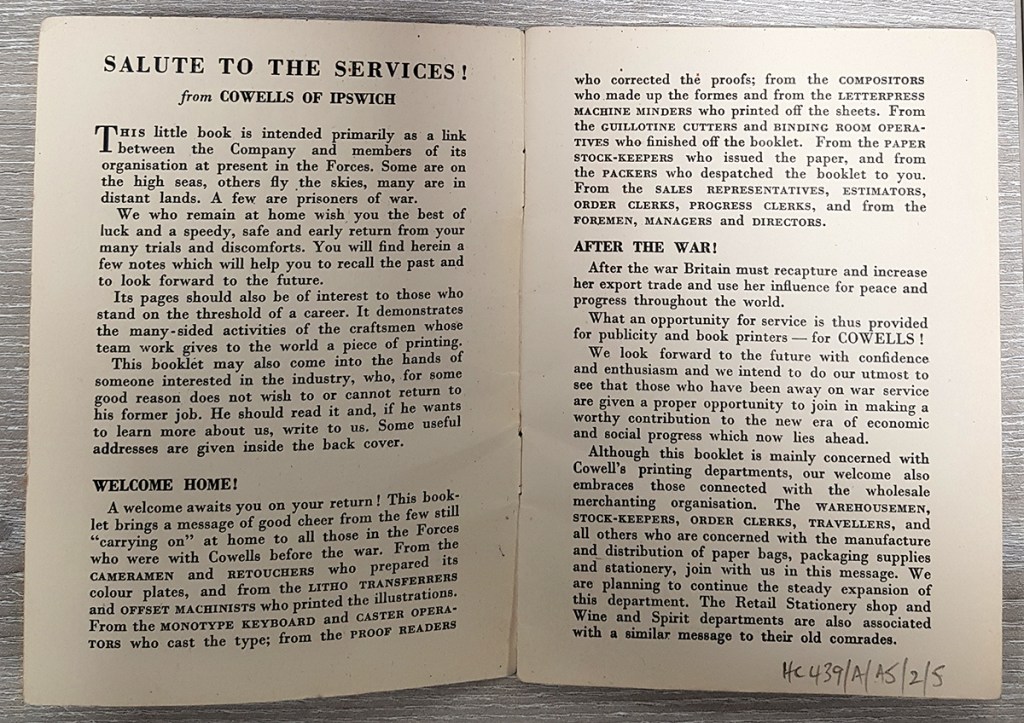
The choice seemed to be made for us when going through texts written by people who worked at W. S. Cowell, or in things the firm published about themselves, and ‘Cowells’ is very much the preferred written form. The printer’s Head of Design, John Lewis, wrote Cowells throughout his autobiography, Such Things Happen: The Life of a Typographer, (Unicorn Press, 1994); and the accompanying essay to Geoffrey Ireland’s photobook of the factory, The Press In The Butter Market, (1959), which was commissioned and published by W. S. Cowell, uses Cowells as well.

That Cowells, sans apostrophe, is how the firm wrote their name on all of their self-publicity material that Rob and I found in the archives, both in large print as well as in body copy, seemed to seal the fate of what we should do. But why then, when writing their name possessively, do they write Cowell’s as opposed to Cowells’? If they have pluralised their name colloquially, why make it singular again by putting the apostrophe before the s? Further, their poor apostrophe usage strayed beyond their own name—in one publication they wrote about themselves, I saw the faux pas of them type-setting ‘the 1930’s’, with a possessive apostrophe, when talking about a decade. So were they just sloppy at this sort of thing?
Vassiliki consulted with a friend of hers who is a linguistic expert at the University of Essex, and they were adamant that the apostrophe should be in place, with an obvious example of the supermarket chain Sainsbury’s. The difference here though being that Sainsbury’s is their registered company name; for the Ipswich printers, their registered name was W. S. Cowell Ltd. This, therefore, is about colloquial usage—the spoken word as written—which is different.
Of course, this is not a new debate, and we are sure whatever we chose to write will prove contentious for some people. Use an apostrophe and we are disrespecting the firm’s wishes, don’t use it and we are being grammatically incorrect. Pedants on either side of the argument would take offence. The furore around Waterstones dropping their apostrophe as part of their 2012 rebrand caused just such a fall-out, despite there being a good rationale in place for them doing so, and that this was their choice of how they wanted their name to be written: see here, here and here.
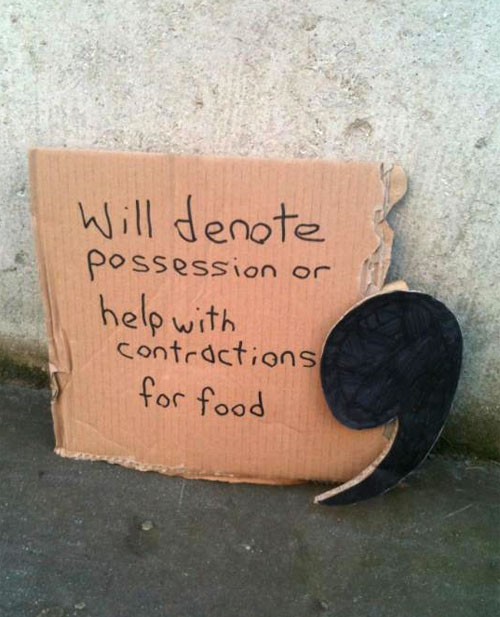
Our debate even entered into the territory of whether as academics we should ‘correct’ poor apostrophe usage. After questioning this as an elitist mindset, and taking on board that regardless of the rights and wrongs of accepted rules, that language does change over time. Regardless, it simply felt wrong for us to correct how Cowells referred to themselves. Picture Books For All is about them after all, and it would look odd were we to use an apostrophe on the display panels while the firm’s own work sits alongside it not having one. That this exhibition will be in Ipswich, the home of the firm for some 170 years until it closed its doors in 1988, could be seen as a double insult, especially by locals visiting the exhibition who may have worked there, or had relatives who once did.
We did agree, however, that we should use the possessive apostrophe correctly when writing their name colloquially, even if this contradicted Cowells’ own usage. The panel text is our writing, when all is said and done, and this would be less about correcting Cowells’ mistakes, and simply getting it right in what we author.

Picture Books for All opens to the public at Suffolk Archives’ The Hold, in Ipswich, on Friday 21 October 2022. The exhibition runs until 9 December 2022. For more information and to book free tickets, visit Suffolk Archives’ website.
Afterword: In my previous post about Picture Books for All on this blog, I originally used an apostrophe when referring to Cowells. This debate only reared its head when re-reading and editing the panel text we had written between us. After making our decision, I have since gone back and corrected that post.
 Nigel Ball
You must be logged in to post a comment.